Compliance Mode (SOC2 / HIPAA)
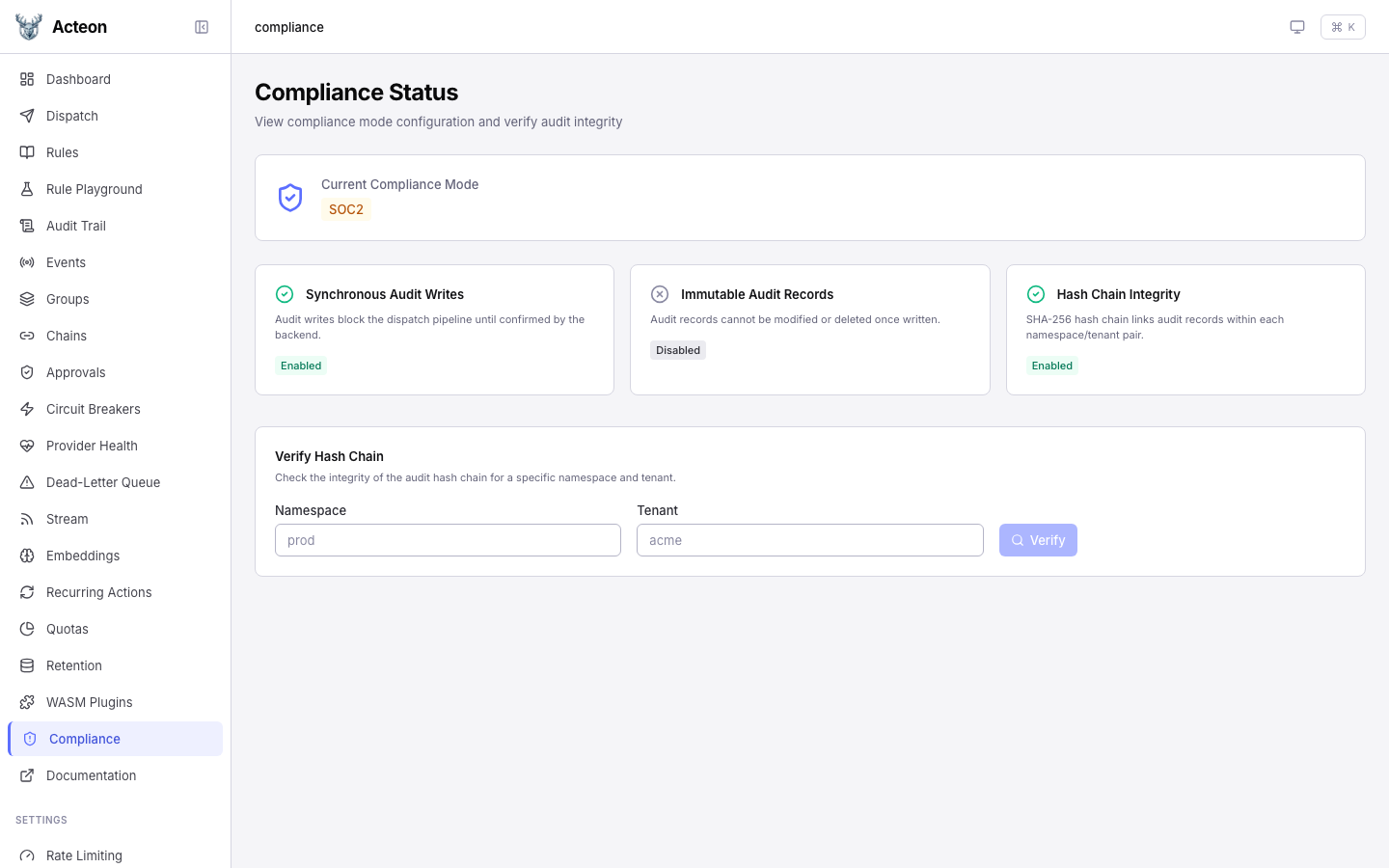
Compliance mode configures the audit pipeline for regulatory requirements. Selecting a mode pre-configures sensible defaults for synchronous writes, hash chaining, and record immutability:
- SOC2 -- synchronous audit writes and SHA-256 hash chaining across records
- HIPAA -- all SOC2 features plus immutable audit records (deletes and updates rejected)
- None -- default behavior with no compliance constraints
How It Works
When compliance mode is enabled, the gateway wraps the audit store with two decorator layers:
-
HashChainAuditStore-- computes a SHA-256 hash of each record's content and links it to the previous record's hash, creating a tamper-evident chain per(namespace, tenant)pair. Each record receivesrecord_hash,previous_hash, and a monotonicsequence_number. -
ComplianceAuditStore-- enforces immutability by rejecting delete and update operations on audit records. Only active whenimmutable_audit = true.
Additionally, when sync_audit_writes = true, the dispatch pipeline awaits the audit write inline rather than spawning it as a background task. This guarantees the audit record is persisted before the dispatch response is returned.
Dispatch Pipeline with Compliance Mode:

  1. Acquire distributed lock
  2. Check quotas
  3. Evaluate rules
  4. Execute action
  5. Build audit record
  6. Hash chain decorator:  compute hash, link to previous
  7. Compliance decorator:  enforce immutability
  8. Write audit record     (sync when sync_audit_writes = true)
  9. Return outcome
Configuration
Via the Gateway Builder (Rust)
use acteon_core::{ComplianceConfig, ComplianceMode};
use acteon_gateway::GatewayBuilder;

// SOC2: sync writes + hash chain
let gateway = GatewayBuilder::new()
    .state(state)
    .lock(lock)
    .compliance_config(ComplianceConfig::new(ComplianceMode::Soc2))
    .build()?;

// HIPAA: sync writes + hash chain + immutable
let gateway = GatewayBuilder::new()
    .state(state)
    .lock(lock)
    .compliance_config(ComplianceConfig::new(ComplianceMode::Hipaa))
    .build()?;

// Custom: start from SOC2 but add immutability
let gateway = GatewayBuilder::new()
    .state(state)
    .lock(lock)
    .compliance_config(
        ComplianceConfig::new(ComplianceMode::Soc2)
            .with_immutable_audit(true)
    )
    .build()?;
Via TOML Configuration
[compliance]
mode = "soc2"              # "none", "soc2", or "hipaa"
# Optional overrides (uncomment to override mode defaults):
# sync_audit_writes = true
# immutable_audit = false
# hash_chain = true
Via the REST API
Check the current compliance status:
Response:
Mode Defaults
| Setting | None | SOC2 | HIPAA |
|---|---|---|---|
sync_audit_writes | false | true | true |
hash_chain | false | true | true |
immutable_audit | false | false | true |
Each setting can be individually overridden after selecting a mode using the with_* builder methods or the TOML override fields.
Backend Requirements
Hash chaining relies on atomic sequence number uniqueness to guarantee correctness across multiple gateway replicas. The postgres or dynamodb audit backend is required for production use of hash_chain = true.
| Audit Backend | Hash Chain Support | Notes |
|---|---|---|
postgres | Full | UNIQUE constraint on (namespace, tenant, sequence_number) ensures exactly-once sequencing via optimistic concurrency control. |
dynamodb | Full | TransactWriteItems with attribute_not_exists condition on a fence item guarantees sequence uniqueness via conditional writes. |
memory | Testing only | Suitable for development and tests. Not persisted across restarts. |
elasticsearch | Not supported | No synchronous unique constraint enforcement. Server will refuse to start. |
clickhouse | Not supported | Asynchronous mutations cannot guarantee sequencing. Server will refuse to start. |
Acteon validates the backend at startup: if hash_chain = true and the audit backend is not postgres, dynamodb, or memory, the server exits with an error. This fail-fast behavior prevents silent data integrity issues.
Multi-Replica Correctness
When running multiple gateway replicas, each replica fetches the current chain tip from the database before writing a new record. If two replicas race on the same (namespace, tenant) pair, the uniqueness enforcement (UNIQUE constraint on Postgres, conditional writes on DynamoDB) causes one write to fail. The losing replica retries with jittered exponential backoff (up to 5 attempts), re-fetching the tip each time. This optimistic concurrency control (CAS) pattern ensures the chain remains consistent without distributed coordination.
Hash Chain
When hash_chain = true, each audit record receives three additional fields:
| Field | Type | Description |
|---|---|---|
record_hash | string | SHA-256 hex digest of the canonicalized record content |
previous_hash | string | Hash of the previous record in the chain |
sequence_number | integer | Monotonic counter within the (namespace, tenant) pair |
The first record in a chain has previous_hash = "genesis" and sequence_number = 1.
Verification
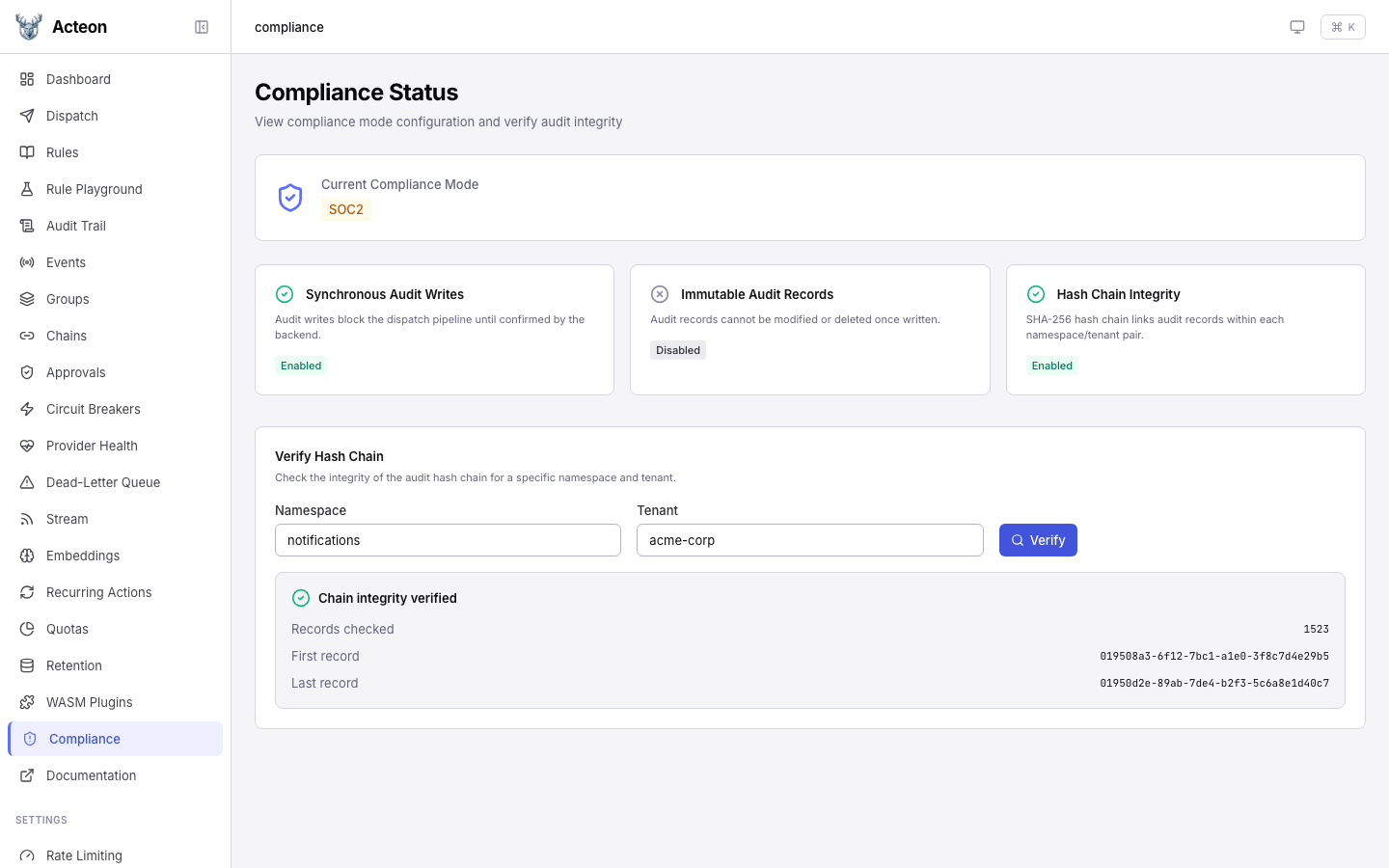
Verify the integrity of the hash chain for a namespace/tenant pair:
curl -X POST http://localhost:8080/v1/audit/verify \
  -H "Content-Type: application/json" \
  -d '{
    "namespace": "notifications",
    "tenant": "acme"
  }'
Optional parameters:
| Parameter | Type | Description |
|---|---|---|
namespace | string | Required. Namespace to verify. |
tenant | string | Required. Tenant to verify. |
from | string | Optional. Start of the time range (ISO 8601). |
to | string | Optional. End of the time range (ISO 8601). |
Response:
{
  "valid": true,
  "records_checked": 1523,
  "first_broken_at": null,
  "first_record_id": "aud-001",
  "last_record_id": "aud-1523"
}
If the chain is broken:
{
  "valid": false,
  "records_checked": 500,
  "first_broken_at": "aud-237",
  "first_record_id": "aud-001",
  "last_record_id": "aud-500"
}
Immutable Audit
When immutable_audit = true, the ComplianceAuditStore decorator rejects:
- Delete operations on individual audit records
- Bulk delete / purge operations
Attempts to delete or modify audit records will return an error:
{
  "code": "COMPLIANCE_VIOLATION",
  "message": "Audit records are immutable in the current compliance mode"
}
This interacts with data retention policies: when both immutable_audit and compliance_hold are active, audit records are fully protected from both manual deletion and automated cleanup.
Synchronous Audit Writes
When sync_audit_writes = true, the dispatch pipeline blocks until the audit record is confirmed written to the backend. This guarantees:
- Every executed action has a corresponding audit record
- No audit record is lost due to process crash between dispatch and async write
- Regulatory requirements for complete audit trails are satisfied
The trade-off is higher dispatch latency (the audit write is on the critical path).
API Reference
GET /v1/compliance/status
Returns the current compliance configuration.
Response (200):
POST /v1/audit/verify
Verify the integrity of the hash chain for a namespace/tenant pair.
Request body:
{
  "namespace": "notifications",
  "tenant": "acme",
  "from": "2026-01-01T00:00:00Z",
  "to": "2026-02-17T00:00:00Z"
}
Response (200):
{
  "valid": true,
  "records_checked": 1523,
  "first_broken_at": null,
  "first_record_id": "aud-001",
  "last_record_id": "aud-1523"
}
Usage Examples
Enable SOC2 compliance
Check compliance status
Verify audit chain integrity
curl -X POST http://localhost:8080/v1/audit/verify \
  -H "Content-Type: application/json" \
  -d '{"namespace": "notifications", "tenant": "acme"}'
Verify a time range
curl -X POST http://localhost:8080/v1/audit/verify \
  -H "Content-Type: application/json" \
  -d '{
    "namespace": "notifications",
    "tenant": "acme",
    "from": "2026-02-01T00:00:00Z",
    "to": "2026-02-17T00:00:00Z"
  }'
Interaction with Other Features
- Data Retention: Compliance hold on a retention policy prevents the reaper from deleting audit records. Combined with
immutable_audit, records are fully protected. - Payload Encryption: Hash chaining operates on the encrypted payload. The hash covers the ciphertext, not the plaintext.
- Audit Trail: Compliance mode adds three fields (
record_hash,previous_hash,sequence_number) to each audit record. These are visible in the audit API response and the Admin UI.
Best Practices
- Use Postgres or DynamoDB for compliance: Hash chaining requires the
postgresordynamodbaudit backend. Plan your deployment accordingly before enabling SOC2 or HIPAA mode. - Choose the right mode: Use SOC2 for financial/operational audit trails. Use HIPAA for healthcare or any scenario requiring immutable records.
- Start with SOC2: If unsure, SOC2 provides strong audit guarantees without the operational constraints of full immutability.
- Monitor dispatch latency: Sync audit writes add latency. Use the provider health dashboard to track p95/p99 impact.
- Verify periodically: Run hash chain verification on a schedule (e.g., daily) to detect any data corruption early.
- Combine with retention: Use retention policies with
compliance_hold = truefor tenants under regulatory requirements.
Limitations
- Postgres or DynamoDB required for hash chaining: Hash chain integrity relies on the
postgresaudit backend's UNIQUE constraints ordynamodbconditional writes. See Backend Requirements above. - Gateway-wide setting: Compliance mode applies to all tenants on the gateway. Per-tenant compliance modes are not currently supported.
- Write-time only: Enabling hash chaining does not retroactively hash existing records. Only new records participate in the chain.
- Performance impact: Synchronous audit writes increase dispatch latency. Hash computation and CAS retries add overhead per record.
- No key rotation: The hash chain does not support key rotation. If the hashing algorithm needs to change, a new chain must be started.