Rule Playground
The Rule Playground provides a dedicated debugging endpoint for testing how rules evaluate against a synthetic action, without executing any side effects. Unlike dry-run mode (which uses the full dispatch pipeline), the playground focuses exclusively on rule evaluation and returns a detailed per-rule trace.
Admin UI
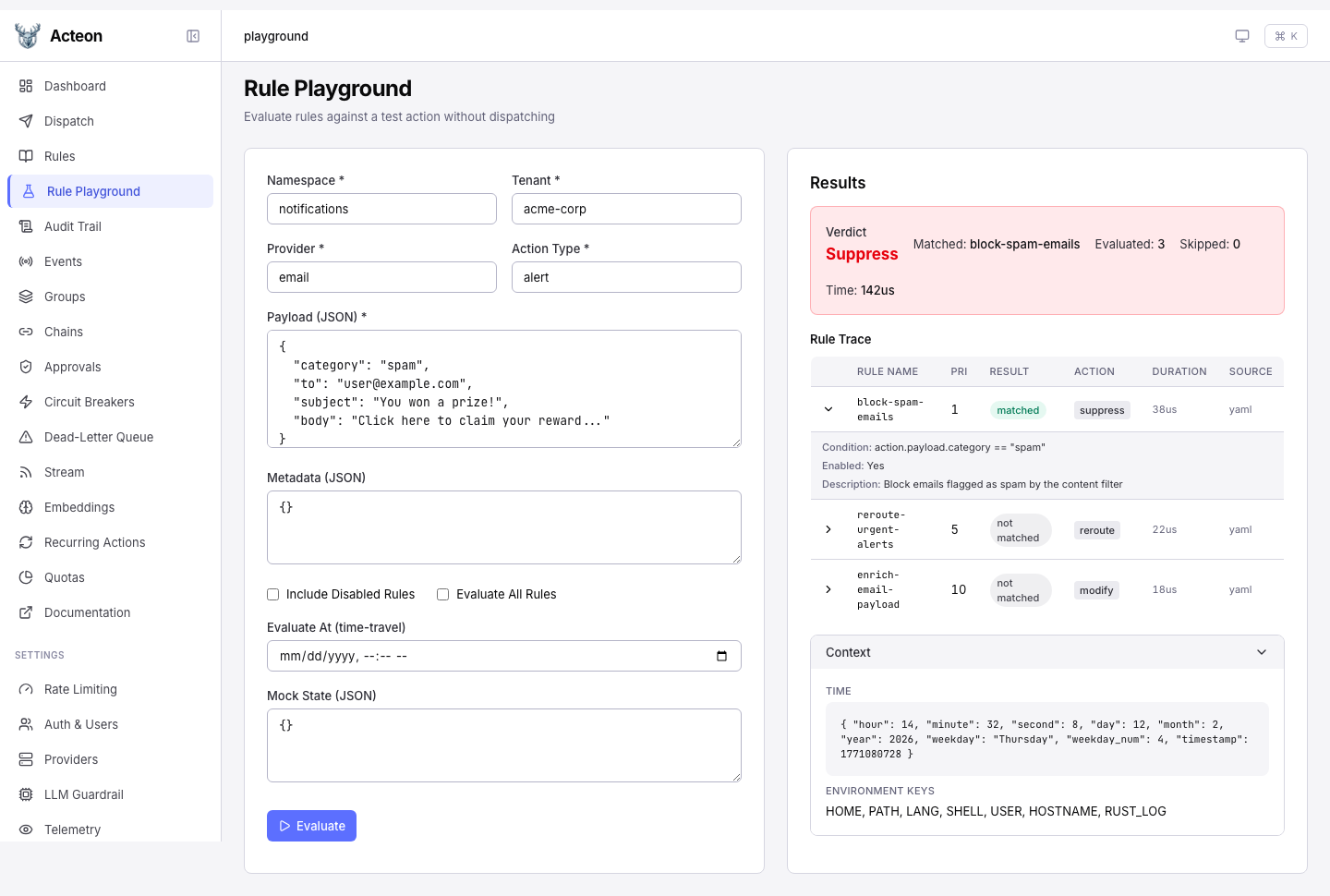
The Rule Playground is available in the Admin UI sidebar. Fill in the action fields on the left, click Evaluate, and inspect the per-rule trace on the right.
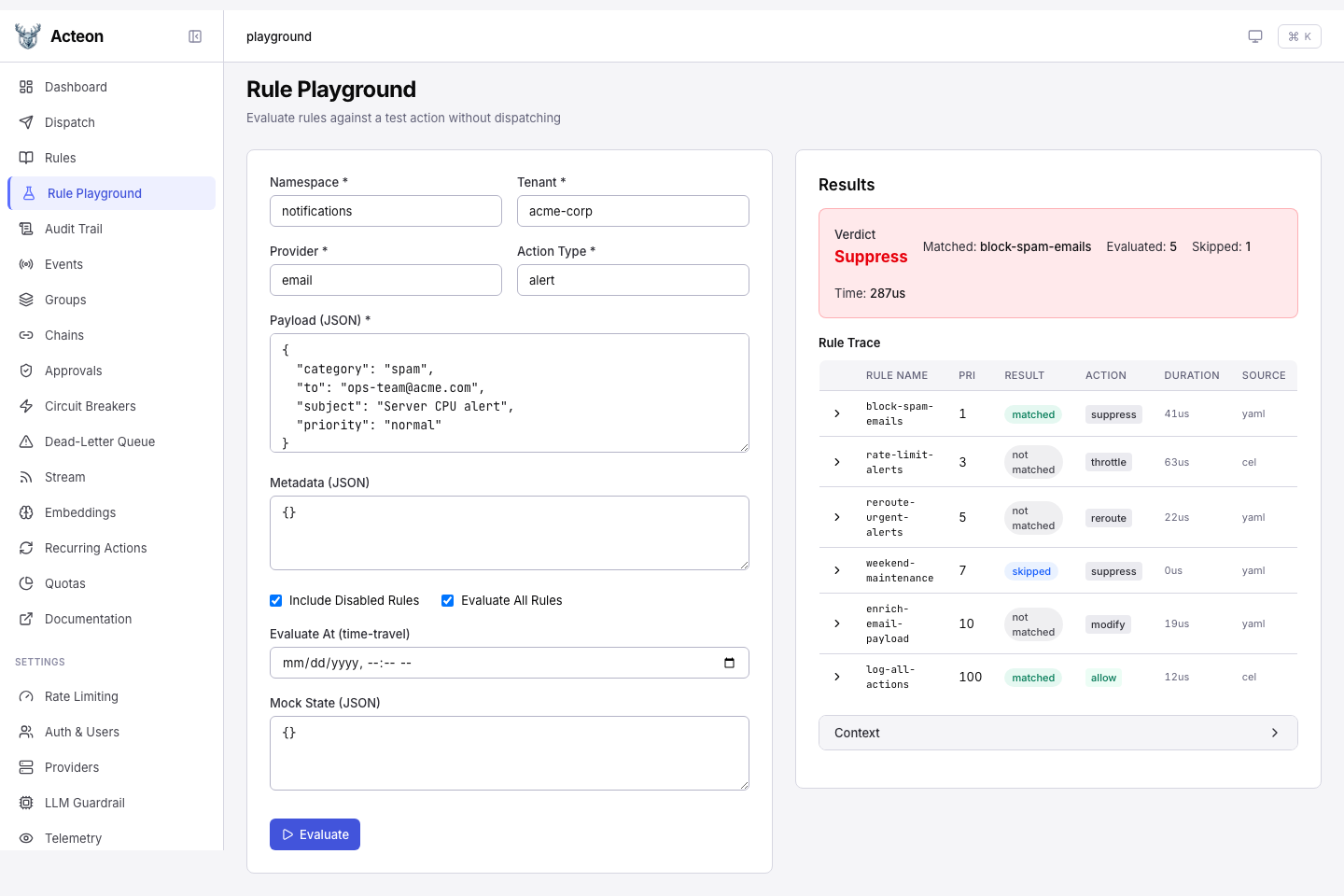
Enable Evaluate All Rules and Include Disabled Rules to see every rule in the trace, including disabled and skipped rules:
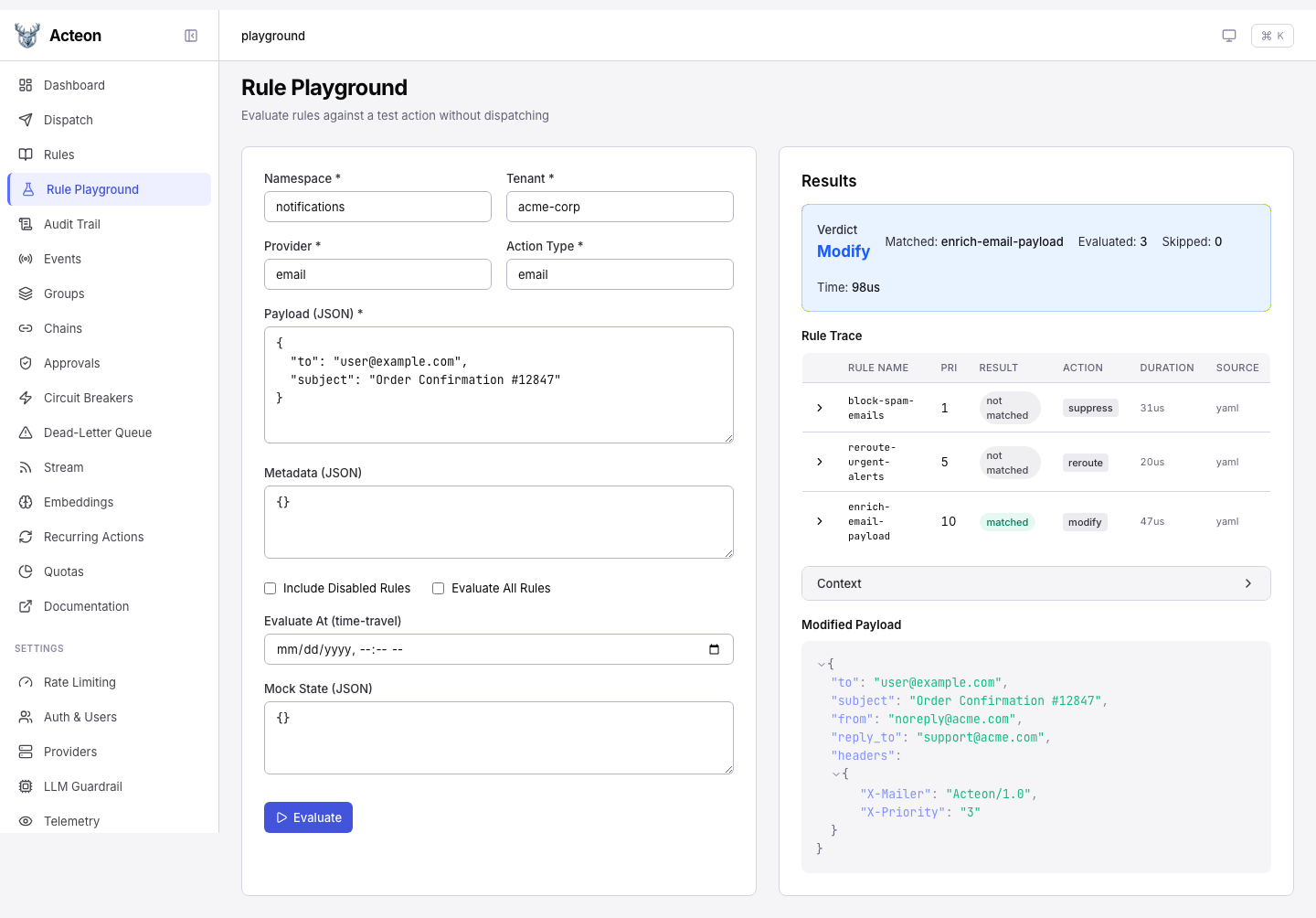
When the matched rule is a Modify action, the modified payload preview appears at the bottom of the results panel:
API Endpoint
Request Body
| Field | Type | Required | Description |
|---|---|---|---|
namespace | string | yes | Namespace for the test action |
tenant | string | yes | Tenant for the test action |
provider | string | yes | Provider for the test action |
action_type | string | yes | Action type for the test action |
payload | object | yes | JSON payload to evaluate against the rules |
metadata | object | no | Optional metadata key-value pairs |
include_disabled | bool | no | When true, disabled rules appear in the trace (marked as skipped) |
evaluate_all | bool | no | When true, evaluates every rule even after the first match |
evaluate_at | string | no | ISO 8601 timestamp override for time-travel debugging |
mock_state | object | no | State key overrides for testing state-dependent conditions |
Response
| Field | Type | Description |
|---|---|---|
verdict | string | Final verdict: allow, deny, suppress, modify, or error |
matched_rule | string? | Name of the first matching rule |
has_errors | bool | true when one or more rules errored during evaluation |
total_rules_evaluated | int | Number of rules whose conditions were evaluated |
total_rules_skipped | int | Number of rules that were skipped |
evaluation_duration_us | int | Total evaluation time in microseconds |
trace | array | Per-rule trace entries in priority order |
context | object | Evaluation context (time map, environment keys, timezone) |
modified_payload | object? | Resulting payload after merge patch (only for modify verdicts) |
Each trace entry contains:
| Field | Type | Description |
|---|---|---|
rule_name | string | Name of the rule |
priority | int | Rule priority (lower = evaluated first) |
enabled | bool | Whether the rule is enabled |
condition_display | string | Human-readable condition expression |
result | string | matched, not_matched, skipped, or error |
evaluation_duration_us | int | Time spent evaluating this rule |
action | string | The action the rule would take |
source | string | Where the rule was loaded from |
description | string? | Optional rule description |
skip_reason | string? | Reason the rule was skipped |
error | string? | Error message if evaluation failed |
Key Features
Evaluate All Rules
By default, rule evaluation stops at the first match. Set evaluate_all: true to force evaluation of every rule, which is useful for understanding the full rule set's behavior:
curl -X POST http://localhost:8080/v1/rules/evaluate \
  -H 'Content-Type: application/json' \
  -d '{
    "namespace": "default",
    "tenant": "acme",
    "provider": "email",
    "action_type": "notification",
    "payload": {"to": "user@example.com"},
    "evaluate_all": true
  }'
Time-Travel Debugging
Override the evaluation clock to test time-sensitive rules (maintenance windows, weekday restrictions, etc.):
{
  "namespace": "default",
  "tenant": "acme",
  "provider": "email",
  "action_type": "notification",
  "payload": {},
  "evaluate_at": "2026-03-15T03:00:00Z"
}
Mock State
Override state keys to test state-dependent conditions without mutating real state:
{
  "namespace": "default",
  "tenant": "acme",
  "provider": "email",
  "action_type": "notification",
  "payload": {},
  "mock_state": {
    "alert_count": "5",
    "last_notified": "2026-02-12T10:00:00Z"
  }
}
Error Visibility
When a rule condition errors during evaluation, the verdict is set to "error" and has_errors is true. The failing rule's trace entry contains the error message. This matches production behavior where errors before the first match cause the engine to abort.
Modify Payload Preview
When the matched rule is a Modify action, the response includes modified_payload showing the result of applying the JSON merge patch to the input payload.
Default Fallthrough
When no rules match, a synthetic (default fallthrough) trace entry is appended, making it explicit that the allow verdict came from no rule matching rather than a specific rule.
Client SDK Usage
Rust
use acteon_client::{ActeonClient, EvaluateRulesOptions};
use acteon_core::Action;

let client = ActeonClient::new("http://localhost:8080");
let action = Action::new("ns", "tenant", "email", "send", serde_json::json!({}));

let trace = client.evaluate_rules(&action, &EvaluateRulesOptions {
    evaluate_all: true,
    ..Default::default()
}).await?;

println!("Verdict: {}", trace.verdict);
for entry in &trace.trace {
    println!("  {} -> {}", entry.rule_name, entry.result);
}
Python
from acteon_client import ActeonClient, EvaluateRulesRequest

client = ActeonClient("http://localhost:8080")
result = client.evaluate_rules(EvaluateRulesRequest(
    namespace="ns",
    tenant="tenant",
    provider="email",
    action_type="send",
    payload={},
    evaluate_all=True,
))

print(f"Verdict: {result.verdict}")
for entry in result.trace:
    print(f"  {entry.rule_name} -> {entry.result}")
Node.js / TypeScript
const result = await client.evaluateRules({
  namespace: "ns",
  tenant: "tenant",
  provider: "email",
  action_type: "send",
  payload: {},
  evaluate_all: true,
});

console.log(`Verdict: ${result.verdict}`);
result.trace.forEach(e => console.log(`  ${e.rule_name} -> ${e.result}`));
Go
resp, err := client.EvaluateRules(ctx, acteon.EvaluateRulesRequest{
    Namespace:   "ns",
    Tenant:      "tenant",
    Provider:    "email",
    ActionType:  "send",
    Payload:     map[string]interface{}{},
    EvaluateAll: true,
})
fmt.Println("Verdict:", resp.Verdict)
Java
EvaluateRulesResponse resp = client.evaluateRules(
    new EvaluateRulesRequest("ns", "tenant", "email", "send", Map.of())
        .evaluateAll(true)
);
System.out.println("Verdict: " + resp.getVerdict());
Security Notes
- Environment variable keys are filtered to omit names containing
SECRET,PASSWORD,TOKEN,CREDENTIAL, orPRIVATE_KEY(and names ending in_KEY). Values are never exposed. - The endpoint is read-only: no state mutations, no provider calls, no audit records.
- Authentication and authorization apply as with any protected endpoint.